

REGISTER
JOIN WAITLIST
Email [email protected]
The Challenge Wanaka Multi event features a 25km kayak, 43km mountain bike and a 14km trail run. Or you can skip the kayak and sign up for our duathlon option.
Competitors take on a 25km kayak across the pristine waters of Lake Wānaka, followed by a 45km mountain bike through diverse trails, and finish with a 14km trail run showcasing the region’s breathtaking landscapes. For those who prefer to stay on land, the duathlon option allows participants to skip the kayak and tackle just the bike and run. Whether solo or in a team, this event promises an epic challenge in one of the world’s most scenic multisport destinations.
This event is now sold out! Didn’t secure a spot? Don’t lose hope just yet. Athlete plans can change, and places occasionally become available. To join the waitlist, simply email [email protected] with your name and preferred event, and we’ll contact you if an entry becomes available.
THE COURSE
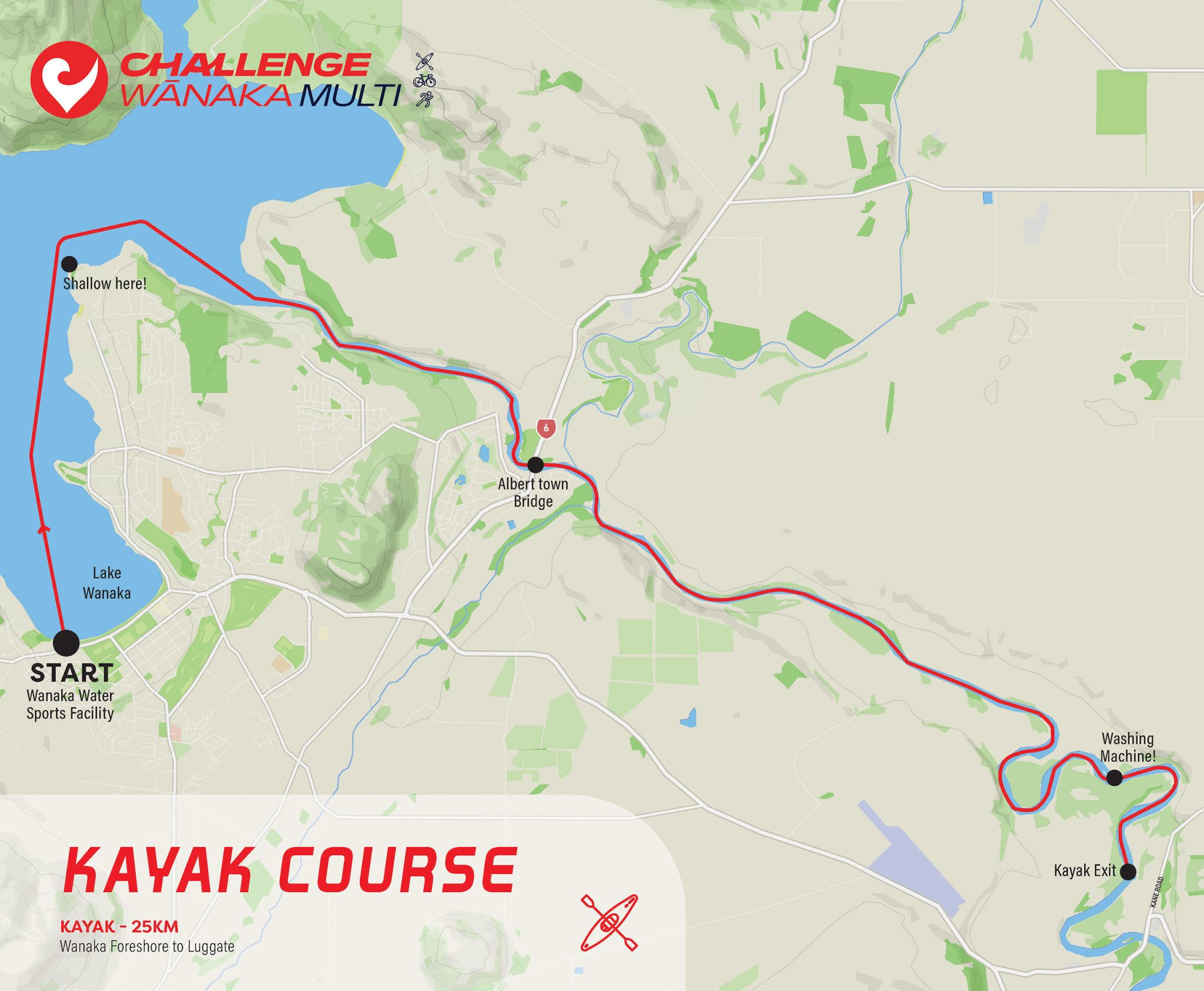
Kayak – 25km
Start on shore outside Lake Wānaka Watersports facility, paddle around Beacon Point to outlet of Lake Wānaka, note that you should paddle well out into lake from Beacon Point to outlet due to large rocks under surface and shallow water. This section can get extremely rough – we recommend practicing kayaking in rougher water in preparation.
You are now on the Clutha river from the Outlet Motor Camp. You can expect wave trains, boils, large eddies and choppy sections. This section from Albert Town to Luggate is lined with willow trees; do not swim or kayak into willow trees they are not your friend! If you fall out near willow trees do a deep water rescue or swim down river till you find a suitable gap on shore you can safely swim into.
The Clutha river is a grade 2 section; you will love this piece of water it’s a stunning paddle! The get out is on the gravel beach 2.5km above the Luggate Red Bridge on true left of river.
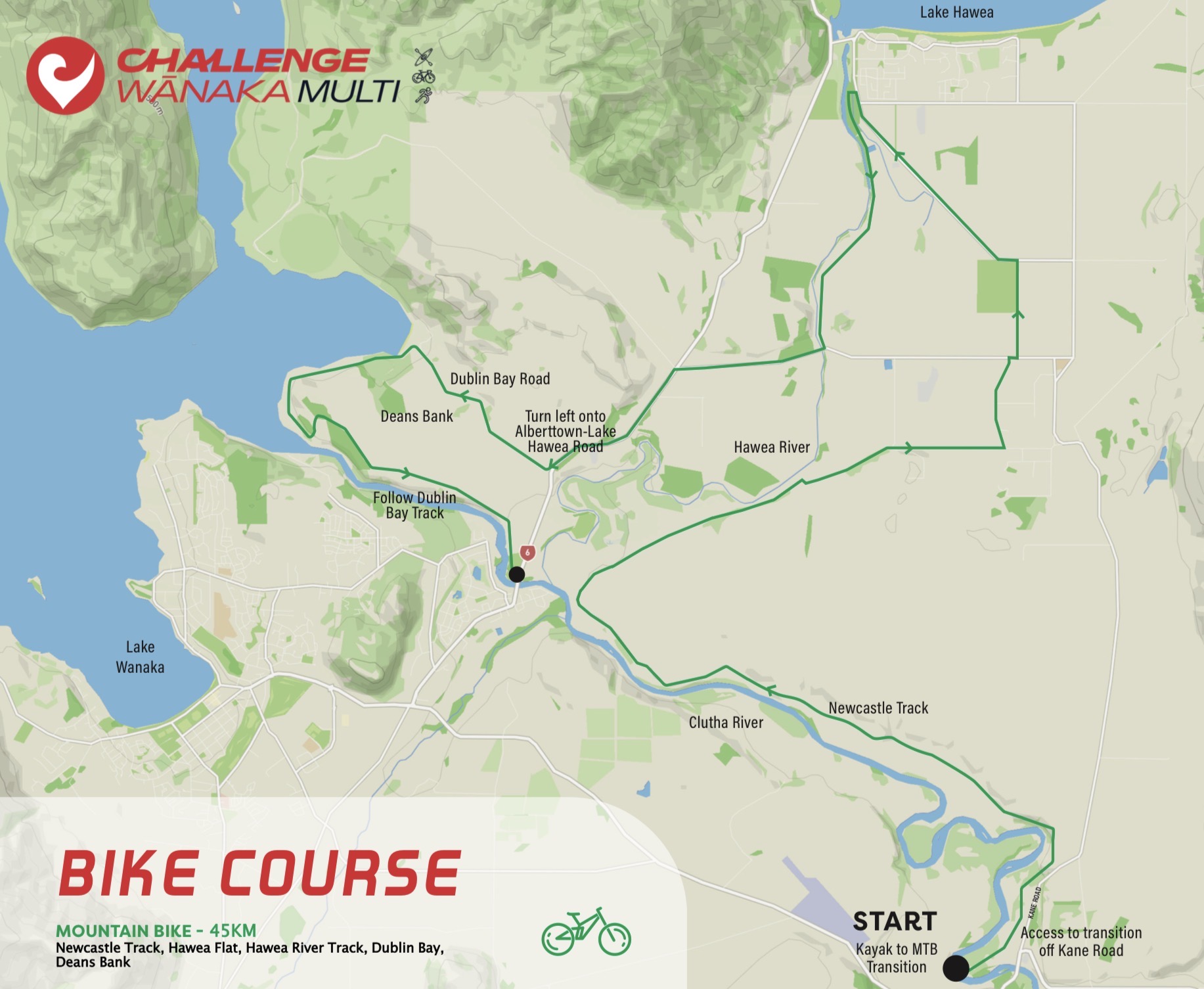
Mountain Bike – 45km (Approx. 1hr 52min)
The Challenge Wānaka Multi bike course starts at T1 on the Newcastle Track, immediately putting riders onto a flowing singletrack along the true left of the Clutha River. From here, riders link onto the Devon Link Track and head toward Hāwea Flat, where the terrain begins to open up. The course transitions onto Lachlan Road before connecting into the School Route Track along Domain road, guiding athletes toward Lake Hāwea. This section mixes trail and some road riding, rewarding those who can adapt their pace and stay efficient as the terrain changes.
Reaching Hāwea, the course turns back toward Albert Town via the Hāwea River Track, coming out at Camp Hill Road. This is a key section of the course—flowing riverside singletrack that allows you to carry speed, but with enough variation to keep you working.
From there, riders head out along Camp Hill Road for a short 3km on the State Highway to Dublin Bay Road, where the course opens up again. Expect faster, more exposed riding here as you make your way toward Dublin Bay.The final phase brings you onto the iconic Deans Bank Trail—a flowing singletrack finish. It’s a rewarding but demanding way to close out the ride. This trail is known for its flowing design and continuous turns, making it both fun and physical.
This course is all about adaptability. It starts smooth and flowing, opens into more exposed and strategic riding, then finishes with one of Wānaka’s most iconic trail sections. It rewards athletes who can manage effort, stay efficient across changing terrain, and a bit of fun!
Gravel bikes are permitted this year, alongside mountain bikes. There is not seperate category, all will be classified as one category.
No aero bars are allowed on any bikes. E-bikes will not be permitted on the course. The proposed new course is subject to permissions.
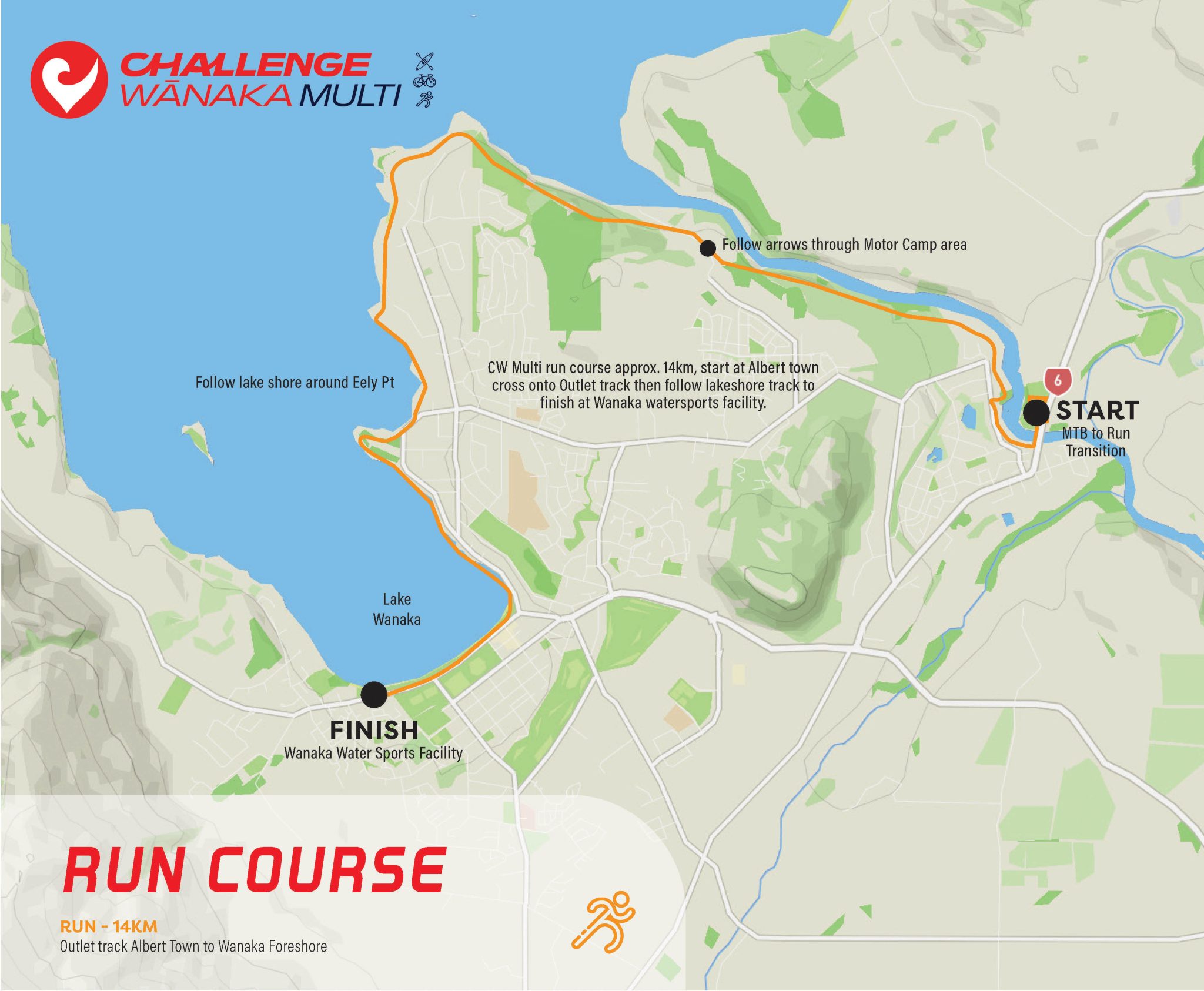
Trail Run – 14km (Fast time – 1hr)
From the camping ground at Albert Town cross the bridge along SH6, use the footbridge cross the river to true right side of the river and continue up the river to the outlet river track. Follow this scenic track all the way up the river to the Outlet Motor Camp (be aware of other track users when on this single track section). Follow the arrows on the Beacon Point track and continue this track back to Wānaka via Eely Point. Ensure you follow arrows on tricky sections until you run around the Wānaka foreshore back to the Wānaka Watersports Facility – you have now completed the race, well done!
KAYAK COURSE
BIKE COURSE
RUN COURSE
EVENT CATEGORIES
This event offers a number of categories for individuals and teams to compete:
- Multi Individual
- Multi team (2 or 3 person)
- Multi tandem team
- Secondary School Multi Individual
- Secondary School Multi Team
- Secondary School Multi Tandem
If you’d like to skip the kayak, then check out the duathlon options for the Duathlon
For secondary school students a parent or guardian needs to purchase the team online and they will become the Team Manager. During this process they will set up a Team Name and password. In their confirmation email the Team Manager will receive a link which they must send, along with the Team Name and password, to each athlete to complete their registration.
EVENT SCHEDULE
| TIME | ACTIVITY | LOCATION |
|---|---|---|
| FRIDAY 16 OCTOBER | ||
| 2.00pm – 7.00pm | Registration | Wānaka Watersports Facility |
| 5.00pm | Volunteer Briefing | Wānaka Watersports Facility |
| SATURDAY 17 OCTOBER | ||
| 6.00am | Transition open for bike/run drop off | T2 Albert Town |
| 7.45am | Compulsory briefing at Kayak Start | Wānaka Watersports Facility |
| 8.00am | Individuals Start | Wānaka Watersports Facility |
| 8.15am | Teams Start | Wānaka Watersports Facility |
| 9.45am | Duathlon Briefing | T1 Near Red Bridge on Newcastle Track |
| 10.00am | Duathlon Start | T1 Near Red Bridge on Newcastle Track |
| 10.15am | All athletes off water | |
| 12.30pm | First finisher expected | Wānaka Watersports Facility |
| 3.00pm | T1 closed. Leaving any gear after this point is at the athletes’ risk as the transition will no longer be staffed. | |
| 4.00pm | Prize Giving | Wānaka Watersports Facility |
| 5.00pm | Course cut off | |
OTHER INFORMATION
- Age Group categories for Individual New Zealand Multisport Championships for which trophies will be awarded to the top three in the following age groups:
-
- 18-39 (Male & Female)
- 40-55 (Male & Female)
- 56 plus (Male & Female)
- Tandem teams
- 2-3 Person teams
- Individual athletes must be a minimum of 18-years-old on race day. Secondary School Category Individual athletes must be a minimum of 16-years-old on race day.
- Team athletes must be a minimum of 16-years-old on race day. Younger team athletes may be able to compete at the discretion of the Race Director.
- Course closes at 5pm on race day. Athletes finishing after this time will get a DNF.
- Kayak cut-off for individuals and teams is 10:30am. Any athletes who finish after the cut off will get a DNF .
- All transitions will close at 5pm. Leaving any gear after this point is at the athlete’s risk as the transition will no longer be staffed.
All new competitors must send a copy of their Grade 2 Kayak Certificate prior to the event.
Competitors who have successfully completed the river section in the Kathmandu Coast to Coast event, in a single kayak or as the steering member of a tandem, in the last 5 years need only state on the entry form the year(s) they have competed in the Coast to Coast rather than send in another kayaking certificate. If your certificate is older than 2 years and you have not completed the race for 5 years you will need to either complete a refresher Grade 2 course or apply for an exemption supplying evidence of your recent and relevant kayaking experience. We highly recommend people re-certify every 5 years especially if not regularly involved in grade 2 or greater kayaking.
In the Tandem Section, the steering is at the front of the supplied boats and the person steering the kayak MUST have a full Grade 2 Kayak certificate. The second non steering paddler must have a MINIMUM of a river safety certificate which is the completion of the safety section of the Grade 2 Kayak certificate . We also highly recommend you complete a river trip in a double kayak. If the steering kayaker is injured the team member will not be allowed to swap positions and steer the kayak unless they also have a full Grade 2 Kayak Certificate.
It is the competitor’s responsibility to have adequate skills to negotiate and avoid the hazards on a grade 2 river. Officials have the right to withdraw any competitor that in the official’s opinion does not have the skills to safely complete the river section Competitors must put training time in on grade 2 rivers and ensure their choice of kayak is matched to their ability.
Compulsory Kayaking Equipment:
- Air bags / foam pillars 20 litre minimum.
- Paddle, repair tape, spray skirt, kayak helmet, life jacket (50n of buoyancy type 406 with whistle attached).
- Gloves, hat.
- Long sleeved paddle jacket, seam sealed.
- Thermal long sleeved top, long leg thermal bottoms.
- Foil survival bag.
- First aid kit.
- Any medication you require.
Competitors may use any type of kayak except wave riders, inflatable or sit on kayaks. Pods are not allowed on kayaks. River-specific surf skis may be used but must gain clearance from the River Safety team at least two weeks prior to the race to ensure suitability. Surf skis must satisfy the following criteria to be considered:
- Dedicated over-stern rudder.
- River specific, single skin construction on hull.
- River specific venturis – highly recommended to have bailer style drain (venturis must have bungs for venture ports in case cowlings are damaged in shallows).
- Competitor must also have an extra lower body layer – either dry-pants, wetsuit, Sharkskin or similar lower body garment.
All kayaks must have pillars and two floatation/air bags or extensive watertight sealed compartments that are drainable. The minimum requirement is two rear floatation/air bags of 20 litres each – correctly inflated and secured in the kayak. Wine bladders are not acceptable! Kayaks must have a grab loop at the nose of the kayak. Tandem kayaks supplied by organisers (and most sea kayaks) have large watertight bulkheads for storing gear which also act as a buoyancy aid if capsized, so no additional floatation is required if using these boats. Kayaks using storage bulkheads as floatation MUST HAVE waterproof hatch cover FITTED before entering the river.
Competitors who withdraw must not leave the riverbank. They must wait for the river officials to officially withdraw them from race.
Kayak Hire for Challenge Wānaka Multi
Don’t have your own kayak for the Challenge Wānaka Multi? No problem — Paddle Wānaka have you covered.
Paddle Wānaka are proud to supply quality kayaks for competitors who aren’t travelling with their own. To secure your kayak, bookings must be made in advance and pre-paid — no exceptions will be made on the day.
To book your kayak or make an enquiry, please contact: [email protected]
Make sure you’re sorted early so you can hit the water with confidence on race day!
Portages may be used to avoid hazards – they may be recommended or compulsory. Specific information will be given in the Race Briefing. Anyone failing to follow an official’s instruction may be withdrawn from the race.
To help prevent the spread of freshwater pests we encourage you if you’re out on the water, on the boat, the kayak, or swimming take a moment to:
 your gear for stowaway pests and remove these either or by putting them in the rubbish bin,
 your gear thoroughly, and
 it for 48 hours before relocating to another waterway!
Check, Clean, Dry, vastly reduces the risk of aquatic pests hitchhiking from one waterway to another aboard our vessels and gear.
For more information see following handouts or visit Otago Regional Council Guidelines
Compulsory Biking Equipment:
All bikers must wear a helmet as per the specifications in the tab below and carry a repair kit.
We recommend a bike check with our mates at Racers Edge or a local bike shop before competing. Each participant is responsible for the state or repair of his/her own bike. Bikes must have been serviced within three weeks of the event and be in a safe and roadworthy condition. Assistance by anyone other than event officials will be grounds for immediate disqualification. This disallows the use of spare wheels and back-up bikes and requires that each competitor be prepared to handle any possible mechanical malfunction.
The following helmet standards are required: ASTM – F1447-1994, Australia and NZ Standards – AS/NZS 2063:1996 or NZS 5439 or AS2063.2, Snell-B90 or B95, CE European Standards-EN1078, US Consumer Products Safety Standards – USCPS.
- No drafting is permitted, with the exception of teams of two in the ‘Tandem’ who can draft on the cycle leg. The cycle draft zone is a ten metre long by three metre wide rectangle between the front wheel edge of the lead cycle and the front edge of the following cycle, extending each side of the cycle by 1.5 metre, measured from the leading edge of the front wheel. Another athlete has 20 seconds to pass through that zone. Likewise, once an athlete is passed they have 20 seconds to drop back out of the draft zone.
- Vehicle draft zone (including motorbikes) will be a rectangle thirty-five (35) metres long by five (5) meters wide, which surrounds every vehicle on the cycle segment. The front edge of the vehicle will define the centre of the leading 5 metre edge of the rectangle.
- Competitors must obey all traffic laws, traffic rules and the directions of Event officials and the Police. The road is open to normal traffic at all times, please be careful when running on and crossing roads.
- Hiking poles are permitted on the run but please do not obstruct other runners.
- Slower competitors must keep to the left with other competitors overtaking on the right.
You must wear the race number and transponder as directed by the Event officials.
You acknowledge that:
- if the transponder fails, you may not receive a time record and will have no claim against the Organiser or be entitled to a refund of your entry fee;
- you must pay $150 for any transponder that is not returned to the correct Event official.
No individual support vehicles or non-participant escort runners or cyclists are allowed. Friends, family members, coaches or supporters of any type may not bike, drive or run alongside competitors, may not pass food or other items to competitors and should be warned to stay completely clear of all participants to avoid the disqualification of a participant.
All race numbers and transponders will be provided at registration on Friday only. Competitors must not alter the size or appearance of the race number and must wear it clearly and visibly on their front. Failure to do so will result in a disqualification.
Ideally you will have a support crew to assist with the drop-off and collection of kayak, bike, and run gear at each transition area. Having a support person helps ensure a smooth and efficient experience throughout the event and less stress for you.
However, you may also compete without a support crew if you don’t have one. In this case, it is your responsibility to ensure all equipment is transported to the correct locations prior to the race, and collected from the finish or designated areas at the conclusion of the event. Please familiarise yourself with the transition areas and plan your day accordingly to ensure you have enough time.
Please note that support crew are not permitted on course at any time. This includes pacing or providing assistance such as handing out nutrition, drinks, or equipment during the race.